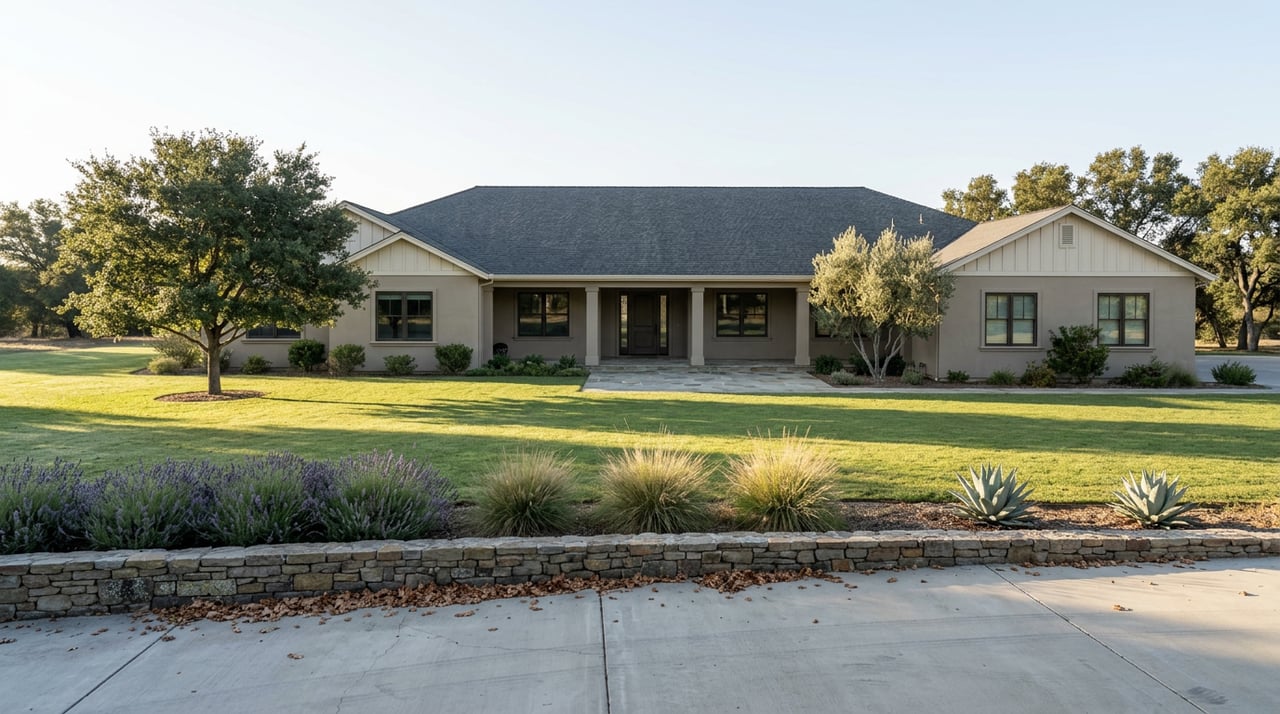
In Yorba Linda, City Zoning Says You Can Keep a Horse. Your HOA Might Say Otherwise.
September 3, 2026
September 3, 2026
Every horse-property listing in Yorba Linda leans on the same three words: zoned for horses. It sounds like a settled fact, the kind of detail a buyer can take at face value and move on. It isn't. The city's zoning code sets the floor for how many horses a parcel can legally hold, but the floor is not the ceiling, and it is often not even the real constraint. The document that actually decides whether you get to keep a horse on a given lot usually isn't the zoning map at all. It's a set of Covenants, Conditions, and Restrictions that most buyers don't request until they're already deep into escrow, if they request it at all.
That gap between what the city allows and what a private HOA permits is the single most common surprise in Yorba Linda's equestrian market. Here is what to check, in the order it actually matters.
Start with what the city actually regulates. Yorba Linda's municipal code ties the number of horses a property can keep directly to lot size and zoning district.
| Lot Size | Zone | Horses Permitted | City Permit Required |
|---|---|---|---|
| Under 10,000 sq ft | Any residential zone | 0 | Not permitted |
| 10,000 to 14,999 sq ft | R-A, RLD, R-E, R-S, or R-U | 1 | Yes, a Conditional Use Permit |
| 15,000 to 17,000 sq ft | R-A, RLD, or R-E | Up to 2 | No, permitted by right |
Above 17,000 square feet the count scales further under the city's table, and properties zoned Open Space carry a different standard entirely, with no minimum lot size but a required 100-foot setback from any adjoining dwelling. The full breakdown lives in Title 18 of the Yorba Linda Municipal Code, and the city's planning division will confirm the specific allowance for a parcel by phone at 714-961-7130.
This table is worth memorizing for one reason: it's the first filter, not the only one. A 12,000-square-foot lot in an R-E zone clears the by-right threshold for nothing and needs a Conditional Use Permit before a single horse moves in. A seller who tells you the property is grandfathered in with more animals than the code allows is describing a nonconforming use, and that use does not automatically transfer to you as the new owner. Confirm current entitlements with the city before you write an offer that assumes the prior owner's setup carries forward.
Here is where most equestrian searches in Yorba Linda actually stall. California's legal hierarchy is clear on paper: zoning sets the outer limit of what a city permits, and a homeowners association cannot expand that limit. What an HOA can do, and routinely does, is restrict further. If the city allows two horses on your 16,000-square-foot lot, a recorded CC&R that prohibits livestock outright still controls. The stricter rule wins, every time.
This matters more in Yorba Linda than the marketing copy suggests, because several of the city's most horse-associated pockets, including gated developments near Vista Del Verde and planned communities like Kerrigan Ranch, operate under HOA governance layered on top of city zoning. A buyer who confirms the zoning table and stops there has confirmed exactly half of what determines their outcome. The other half sits in a document that isn't part of the standard MLS packet: the recorded CC&Rs, retrievable through the property's title company or the Orange County Recorder.
Read past the word "livestock." Some associations permit horses but ban commercial use, meaning no boarding, no paid lessons, no clinics, even on a property the city would otherwise allow to run a small equestrian business under a separate permit. Others cap horse counts below what the zoning table allows, or require architectural review before you build a barn, arena, or even a manure storage area. None of this shows up in a real estate flyer that says zoned for horses. It shows up in a document you have to ask for.
A related soft claim shows up constantly in listing language: horse trail access. Yorba Linda genuinely has an extensive equestrian trail network, with staging areas at Casino Ridge, Quarter Horse, and Gun Club Road Linear Park, plus the Phillip S. Paxton Equestrian Center as the city's central arena facility. But not every trail a listing agent points to is a recorded public easement.
The city maintains a Master Plan of Trails, and the Park & Trail Permits page spells out how the city treats encroachments on both public and private trail easements. A private trail easement is one created through a specific development approval, tract map, or conditional use permit, and it's owned by the adjacent property owners rather than the city. That distinction matters because a private easement can be restricted or reconfigured by the HOA that manages it, while a public easement generally cannot. Before you count on trail access as part of the property's value, compare what the listing calls a trail against your preliminary title report and the city's trail map. A five-minute check now avoids a conversation later about who actually controls the path behind your fence.
Financing an equestrian property introduces a friction point that a standard single-family purchase doesn't have. Barns, arenas, and multiple outbuildings are special-purpose improvements, and not every appraiser assigned by a lender's rotation has experience valuing them. An appraiser unfamiliar with equestrian product can undervalue functional improvements simply because they lack recent comparable sales to lean on, which puts the loan amount at risk of coming in below the purchase price.
The workaround is to ask your lender directly whether the assigned appraiser has equestrian-property experience, and if not, whether an alternate can be requested. Pulling your own set of recent equestrian comps ahead of time, along with rough cost estimates for any barn or arena upgrades, gives the appraiser something concrete to work from rather than starting from scratch on a property type they don't see often.
Equestrian and acreage properties in Yorba Linda consistently price above the city's typical single-family product, and the premium is specific rather than generic. It buys usable land plus the improvements that make horsekeeping practical: covered stalls, arena footing, tack storage, and often a second structure on the parcel.
The range varies with what's already built. A roughly half-acre lot zoned for four horses with eight existing stalls and an arena represents a different price point than a two-acre parcel permitted for as many as twenty-eight horses with a full commercial-scale setup of stalls, grooming bays, and a business office. Both trade as horse property. Only one of them functions as a boarding operation, and that distinction should be reflected in how you evaluate the purchase, not assumed from the word "equestrian" in the listing title.
If your intent is personal use rather than commercial boarding, the larger commercial-capacity properties often carry costs, insurance requirements, and permit obligations that exceed what a private buyer needs. Matching the property's built-out capacity to your actual plans is worth doing before you fall in love with stall count.
Can an HOA really override city zoning that already allows horses? Yes. Zoning sets the maximum a city permits. An HOA operates as a private contract layered on top and can restrict further, including prohibiting horses entirely on a lot the city zoned for them.
Does a Conditional Use Permit expire or transfer with the sale? Confirm this with the city planning division for the specific parcel. Some permits run with the land and transfer to new owners, while others were tied to the original applicant and require reapplication.
Is the whole city the same equestrian zone? No. Allowances vary by district (R-A, RLD, R-E, R-S, R-U, and Open Space each carry different rules), and Planned Development overlays in specific tracts can add another layer of restriction on top of the base zoning.
Buying a horse property in Yorba Linda is entirely workable when the paperwork gets checked in the right order: city zoning first, then the recorded CC&Rs, then the trail easement status, then the financing conversation. Skipping straight from the listing description to the offer is how buyers end up renegotiating in week three of escrow.
If you're comparing specific Yorba Linda parcels and want a second set of eyes on the zoning, the CC&Rs, or what a property's improvements are actually worth against recent local sales, BAIKHOME can walk through the file with you before you write an offer.
Our mission is to become the most trusted source of innovative real estate solutions, creating exceptional experience for all we serve.
BAIKHOME
(714) 882-9212
[email protected]
6281 Beach Blvd Ste 103
Buena Park, CA 90621
ETHAN BAIK | CA DRE# 01927947